Technical
80 GHz vs 26 GHz Radar Level Transmitters: Full Comparison
80 GHz vs 26 GHz radar level transmitter: compare accuracy, beam angle, range, dust performance and price. Get a free application review and RFQ from WELK.
80 GHz vs 26 GHz radar level transmitter: compare accuracy, beam angle, range, dust performance and price. Get a free application review and RFQ from WELK.
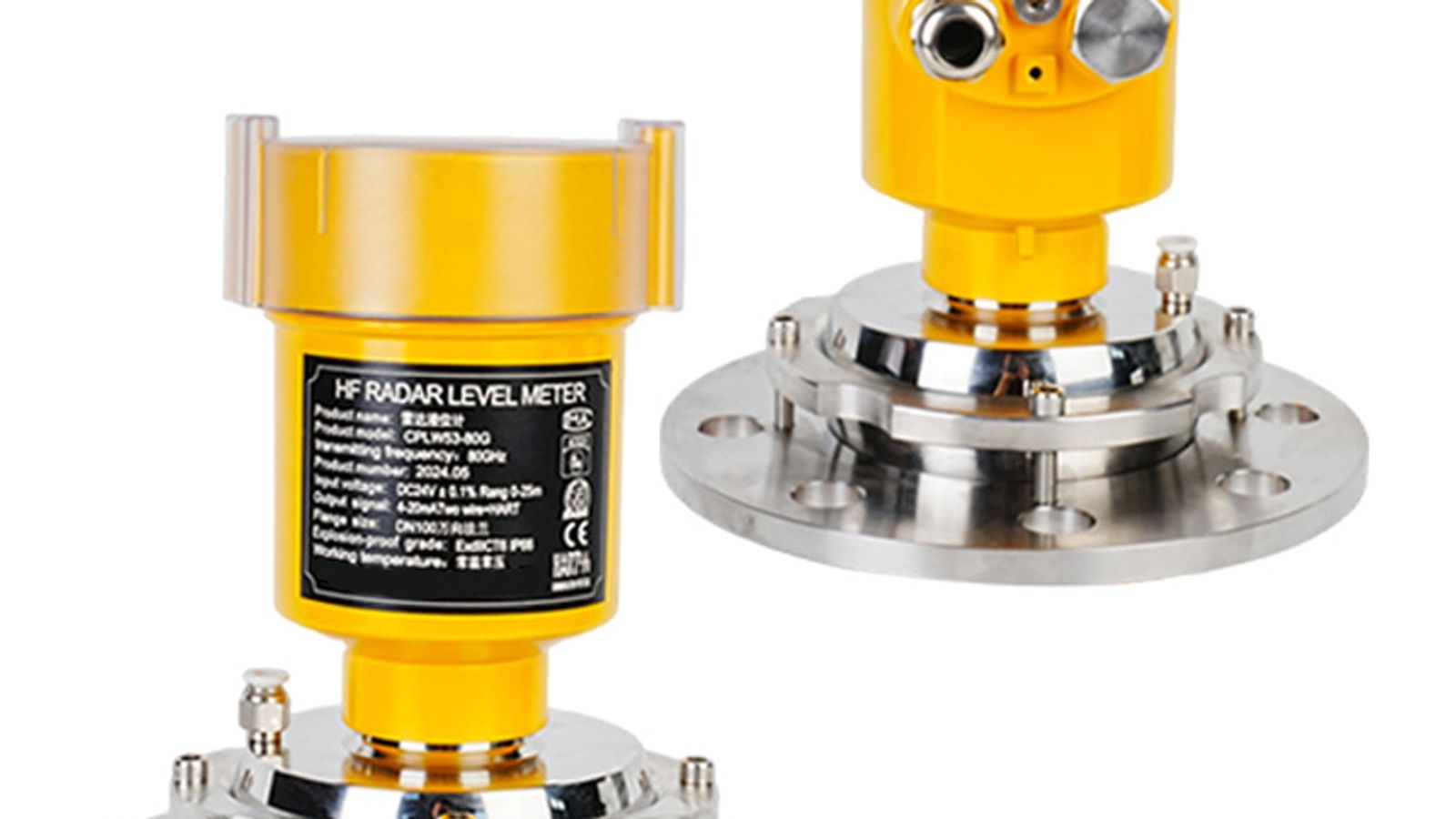
If you are selecting a radar level transmitter for tanks, silos, or bulk solids, the frequency question comes up early: should you choose an 80 GHz radar level meter or a 26 GHz model? The answer is rarely "one is better" — it depends on your vessel, your material, and your process conditions. This guide compares the two frequencies across accuracy, beam angle, antenna size, dust and condensation handling, measurement range, dielectric sensitivity, and price, so you can specify the right instrument the first time.
Both 80 GHz and 26 GHz instruments use the same underlying physics. Radar level measurement transmits microwave energy toward the material surface and calculates level from the echo. The most common technique today is FMCW (Frequency Modulated Continuous Wave): the transmitter emits a continuous signal whose frequency sweeps linearly over time, the reflected echo is mixed with the transmitted signal, and the resulting frequency difference is directly proportional to the distance to the product surface. FMCW delivers better signal averaging and stability than older pulse radar, which measures the round-trip time of discrete short bursts. Because the practical differences between 80 GHz and 26 GHz come down to wavelength, antenna design, and output power, they translate into very different field performance — which is exactly what this article will help you evaluate.
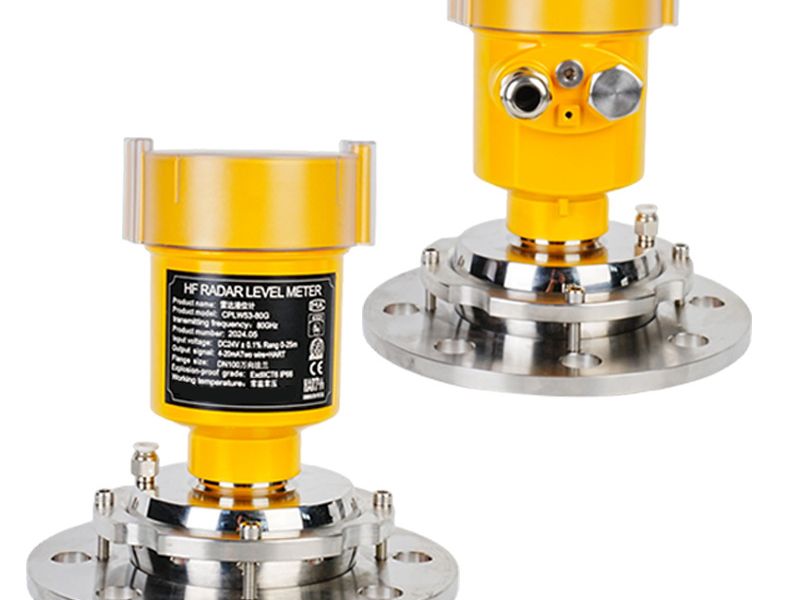
An 80 GHz radar level transmitter operates in the W-band (typically 76–81 GHz), where the wavelength is only about 3.75 mm. That short wavelength is the source of nearly every advantage of 80 GHz instruments. Because the antenna is small at this frequency, manufacturers can build compact transmitters with a 40 mm lens or horn antenna that fits easily into small process nozzles (DN40 or DN50), even on pressurized or high-temperature nozzles where drilling a large hole is impractical.
The short wavelength also produces an extremely narrow beam — around 3° for a typical lens antenna. A narrow beam means the microwave energy is concentrated on the material surface directly beneath the antenna, rather than spraying across the vessel walls. In a dusty silo, that focused beam punches through dust clouds and returns a clean echo from the product, with far less false echo interference from wall buildup, structural internals, or the cone bottom. This is why the 80 GHz class has become the default choice for powder and bulk-solid duty in cement, fly ash, plastics, food, and chemical plants. For a typical application, a compact 80 GHz radar level transmitter delivers an accuracy of about ±2 mm and handles most tank and silo heights found in normal process duty.
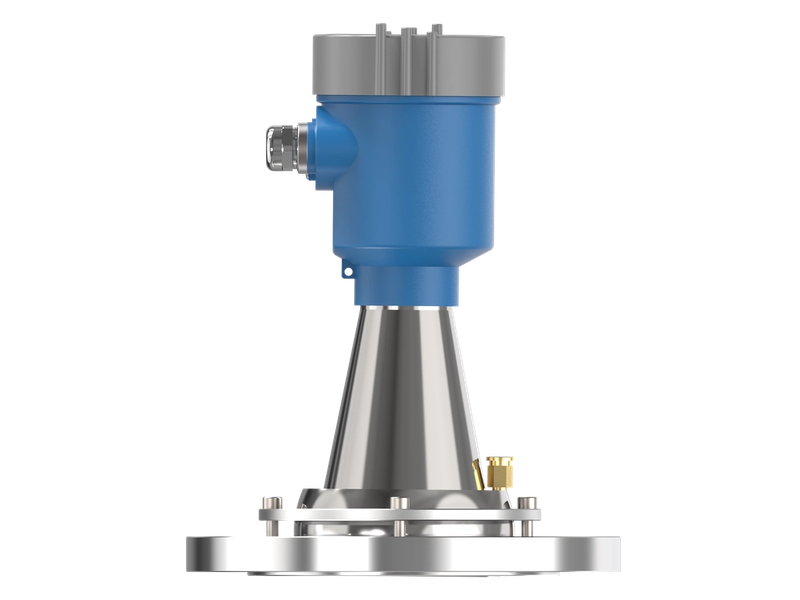
A 26 GHz radar level transmitter operates in the K-band (24–26 GHz), with a wavelength of roughly 11.5 mm. This is a mature, long-serving technology available in both FMCW and pulse versions. Because the antenna must be physically larger to achieve a given beam angle at this longer wavelength, 26 GHz instruments typically use horn or parabolic-drop antennas sized from about 80 mm up to 100 mm or more. A standard 26 GHz horn produces a beam angle of roughly 10°, although larger antennas can narrow it somewhat.
The practical strengths of 26 GHz are long range and process robustness. With more radiated power and a larger antenna aperture, 26 GHz units can measure reliably to 70–120 m, which is why they remain the workhorse for very tall silos and big storage vessels. They also cope better with high-temperature and steam-laden applications: the large metal or PTFE horn antennas are less disturbed by condensation droplets on the antenna face, and the lower frequency suffers less atmospheric attenuation from steam and vapor. A 26 GHz unit with a high-temperature antenna is often the first choice for steam-jacketed tanks, hot bitumen, molten materials, and similar harsh conditions.
The table below summarizes the practical differences a process engineer needs when comparing an 80 GHz and a 26 GHz radar level transmitter.
| Parameter | 80 GHz | 26 GHz |
|---|---|---|
| Typical accuracy | ±2 mm | ~±10 mm |
| Beam angle | ~3° | ~10° |
| Antenna size | 40 mm lens/horn (compact) | 80–100 mm horn/drop antenna |
| Nozzle requirement | DN40–DN50 | DN80–DN100 or larger |
| Dust performance | Excellent — narrow beam focuses on product | Good — wider beam more sensitive to wall interference |
| Condensation/steam performance | Lens more sensitive to condensation | Better — large antennas less affected by condensation |
| Max measurement range | ~30–50 m typical | ~70–120 m |
| Dielectric sensitivity | Works with very low dielectric materials | Best with moderate-to-high dielectric materials |
| Typical price | Cost-effective mid-range | Higher for long-range and high-temperature versions |
The most quoted difference between the two frequencies is measurement accuracy. A well-engineered 80 GHz FMCW radar level meter achieves around ±2 mm repeatable accuracy, while a typical 26 GHz unit is specified at roughly ±10 mm. The short wavelength of 80 GHz is the reason: at a wavelength near 4 mm, the radar resolves much smaller changes in distance, and the FMCW sweep can be processed with fine frequency resolution. That level of precision matters in custody-style inventory control, in small process tanks where a few millimeters of level change represents real volume, and in applications where the product is expensive or where level is tied directly to batch dosing.
For many bulk-solid applications, ±10 mm from a 26 GHz unit is already far more accurate than the alternative technologies it replaces. If your process needs are met by 10 mm accuracy and your dominant requirement is range or temperature rating, the 26 GHz unit loses nothing in practice.
Beam angle is the single most practical difference in the field. At 80 GHz, a 40 mm lens antenna produces roughly a 3° beam; a 26 GHz horn of similar physical size would produce a much wider, less useful beam, so 26 GHz antennas are built larger to compensate. The consequence is a simple selection rule: if you have a small nozzle, an 80 GHz instrument is often the only radar that fits. Vessels with DN40 or DN50 nozzles, including many existing tanks designed for displacer or differential-pressure instruments, can accept an 80 GHz compact transmitter with no vessel modification.
The narrow 3° beam also keeps the radar pointed at the product rather than the vessel wall. In a tank with internal ladders, heating coils, agitators, or beams, a wide 26 GHz beam picks up echoes from those obstacles and requires more echo-processing effort — or a stilling well. The 80 GHz instrument largely avoids wall interference by geometry alone.
Dust is where 80 GHz wins decisively. In a cement silo or a flour silo, dust between the antenna and the product attenuates and scatters the radar signal. The narrow, concentrated 80 GHz beam reaches the material surface with more of its energy intact and returns a stronger echo, so level readings stay stable even during active filling. This is why 80 GHz models, including the WELK cement silo radar level meter, are widely specified for powdered materials. For extreme dust and product buildup on the antenna, an air-purge option blows compressed air or nitrogen across the antenna face to keep it clean — a feature available on both frequencies but especially useful on small 80 GHz lenses.
Condensation and steam favor 26 GHz. Water vapor absorbs higher microwave frequencies more strongly, and a film of condensation on a small 80 GHz lens can scatter the beam noticeably. A 26 GHz horn antenna, with its larger face and lower frequency, shrugs off light condensation and performs more reliably in steam-laden environments such as hot-water tanks, sterilizers, and distillation vessels. If your process sees visible steam or rapid temperature swings that cause condensation, weight this factor heavily — a high-temperature radar level meter in the 26 GHz class is frequently the safer specification.
Range is the clearest advantage of 26 GHz. While most 80 GHz instruments are comfortable to 30–50 m, 26 GHz units with large horns or parabolic drop antennas are rated to 70 m and in some cases to 120 m. Very tall fly-ash silos, coal storage halls, and large aggregate bins often exceed what an 80 GHz lens can reliably cover. For these applications the long-range silo radar level meter in a 26 GHz configuration remains the proven answer. If your vessel height pushes past about 50 m, the range rating — not the accuracy spec — should drive your selection.
Radar needs a dielectric contrast at the material surface to produce an echo. Bulk solids such as cement, plastic pellets, flour, and fly ash have low dielectric constants, and their surfaces can be uneven or dusty. The short 80 GHz wavelength reflects more efficiently off these low-dielectric, fine-particle surfaces, which is one reason 80 GHz radars can measure materials with a dielectric constant down to roughly 1.5–1.6, while a 26 GHz unit typically needs a more favorable surface to return a stable echo from the same powder. For liquids this distinction matters less, because most liquids have higher dielectric constants; but for powders, the 80 GHz frequency's reflection efficiency is a genuine selection advantage.
Price positioning has shifted in recent years. As 80 GHz electronics have become standard and high-volume, an 80 GHz radar level meter is often cost-competitive with — and sometimes cheaper than — an equivalent 26 GHz unit, mainly because the antenna is small and the mechanical design is simple. The cost gap widens in the other direction when a 26 GHz instrument must be specified with a large horn, a long-range configuration, or a high-temperature antenna, all of which add material and machining cost. For a majority of new projects, 80 GHz delivers the better accuracy-to-price ratio; 26 GHz justifies its premium where range or steam/condensation performance is the deciding requirement.
Choose 80 GHz when:
The compact 80 GHz radar level transmitter is the natural default for most new tank and silo installations, and the explosion-proof radar level transmitter extends the same performance to hazardous areas.
Choose 26 GHz when:
For very tall storage, high-temperature service, or steam-heavy processes, the long-range or high-temperature 26 GHz radar level meter is the field-proven option.
Whichever frequency you choose, look for the same supporting capabilities. Both 80 GHz and 26 GHz transmitters are available with air-purge connections for dusty antenna buildup, ATEX and IECEx explosion-proof housings for hazardous areas, and standard 4–20 mA / HART or RS-485 / Modbus outputs for straightforward integration with PLCs and DCS systems. Wireless-IoT-enabled radar level meters are also available where cabling is impractical, such as remote tank farms and mobile storage. These features matter as much as frequency in many projects, and WELK offers them across the product range.
Start with three questions. First, what is the maximum distance from the antenna flange to the lowest level you must measure? If it is under 40 m, 80 GHz covers it. Second, what is in the nozzle and the vessel? A DN40–DN50 nozzle, a dusty powder, or internal obstructions point to 80 GHz. Third, what are the process conditions? Steam, high temperature, or heavy condensation point to 26 GHz.
If accuracy is the priority and range is short, choose 80 GHz. If range or steam is the priority, choose 26 GHz. If your application is dust-heavy — like the silo powder level applications WELK supplies — the 80 GHz frequency is almost always the right starting point. When in doubt, ask the supplier to check the echo profile of your actual vessel; an application review is the fastest way to avoid an expensive wrong guess.
What is the difference between 80 GHz and 26 GHz radar level transmitters?
The main differences are wavelength, beam angle, and antenna size. An 80 GHz radar has a wavelength of about 3.75 mm, a beam angle of roughly 3°, and fits a small 40 mm antenna, giving better accuracy (±2 mm) and better performance on dusty, low-dielectric powders. A 26 GHz radar has a wavelength of about 11.5 mm, a beam angle near 10°, and requires a larger antenna, but offers longer range (up to 70–120 m) and better performance in high-temperature and steam applications.
Is 80 GHz radar better than 26 GHz radar?
It depends on the application. 80 GHz radar is better for high accuracy, small nozzles, dusty silos, and low-dielectric materials. 26 GHz radar is better for very long ranges above 50 m and for processes with steam or heavy condensation on the antenna.
Can an 80 GHz radar level meter work on a cement silo?
Yes. The narrow 3° beam of an 80 GHz radar level meter focuses on the product surface and penetrates dust effectively, which makes it one of the best choices for cement silo level measurement, often with an air-purge option to keep the antenna clean.
What beam angle do I need for a radar level transmitter?
For a clean echo, the beam should hit the material surface without striking the vessel wall. A narrow beam of about 3° at 80 GHz works well in most tanks and silos, including vessels with internal structures. A wider 26 GHz beam around 10° is acceptable in tall, empty vessels but is more prone to false echoes from walls and internals.
Which is cheaper: an 80 GHz or a 26 GHz radar level transmitter?
An 80 GHz radar level meter is usually cost-competitive with a 26 GHz unit for standard applications, and often cheaper because the small antenna makes the mechanical design simpler. A 26 GHz unit becomes more expensive when it needs a large antenna, a long-range configuration, or a high-temperature rating.
Choosing between 80 GHz and 26 GHz radar level measurement is easier when you can test the echo against your real vessel. WELK engineers provide a free application review for tanks, silos, and bulk-solid processes, with honest guidance on frequency, antenna type, and options such as air purge, explosion-proof housings, and digital outputs. Send WELK your vessel dimensions, nozzle size, and material data for a recommendation and a formal RFQ — the right radar level transmitter, specified correctly the first time.
Configurable 80 GHz FMCW radar level meter for storage tanks, process vessels and selected solids with narrow-beam non-contact measurement.
80 GHz radar package with purge connection for dusty silos and applications where antenna buildup can weaken the echo.
Long-range radar level meter for powders, pellets, cement, fly ash and bulk solids storage where dust and uneven surfaces must be reviewed.
Send drawings, dimensions, material, environment or operating conditions, and we will help confirm the right specification.
Uploaded reference files are included with the inquiry. For larger CAD packages, reply to the confirmation email or send them here:
Our team typically replies within 24 hours.