A point level switch is a discrete sensor that detects whether a material has reached a specific height in a vessel and outputs an on/off signal, unlike a continuous level transmitter, which measures height across the full range. Rotary paddle, vibrating rod (tuning fork) and RF admittance level switches are the three most common point-level technologies in process plants, and they work on fundamentally different physical principles: a rotary paddle level switch detects torque on a stalled rotating paddle and is limited to bulk solids above roughly 100 g/L density; a vibrating rod level switch detects a shift in resonant frequency (typically around 250 Hz in air) and can reliably detect powders down to about 20 g/L as well as most liquids; and an RF admittance level switch measures the electrical admittance of its probe with an active shield that cancels coating capacitance, delivering repeatable point detection within about ±5–10 mm across liquids, slurries and many solids. Process temperature ranges from −40 °C up to 250 °C (and higher with extension pieces), pressure ratings from near-atmospheric for paddles up to 40 bar or more for fork and RF types, and response times from about 1–5 seconds — so the right point level sensor depends on the media's density, conductivity, coating behaviour, and the vessel's pressure and temperature.
What Is a Point Level Switch?
Point level measurement answers a simple yes/no question: "is the level at this point or not?" A point level switch is installed at a specific vessel height — high level, low level, or an intermediate set point — and its relay output typically drives an alarm, a pump start/stop, or a valve interlock. This is distinct from continuous level measurement, where a radar, ultrasonic or hydrostatic transmitter reports the exact level at all times — see our level measurement technologies compared guide for the full picture.
For most plant engineers the practical question is not whether to use point level at all, but which point-level principle suits the media. Powders, slurries and liquids behave very differently at a sensing element: a powder packs and jams a mechanical paddle, a slurry leaves a sticky coating on a probe, and a clean liquid simply dampens a vibrating element. The three dominant approaches — mechanical torque detection, resonant frequency shift, and electrical admittance with active shielding — map almost one-to-one onto those behaviours, which is why most suppliers carry all three families.
Rotary Paddle Level Switch: The Mechanical Workhorse for Bulk Solids
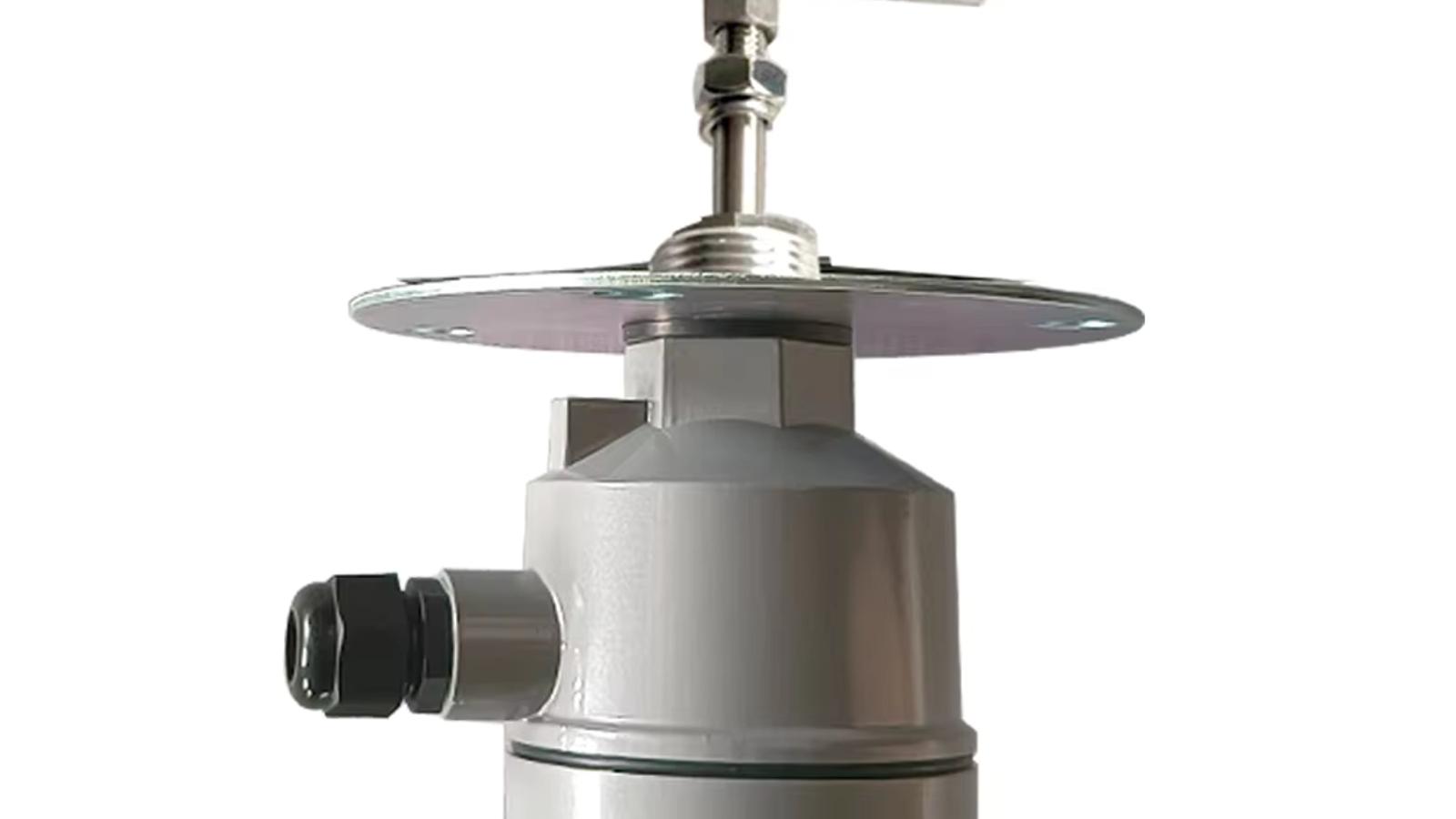
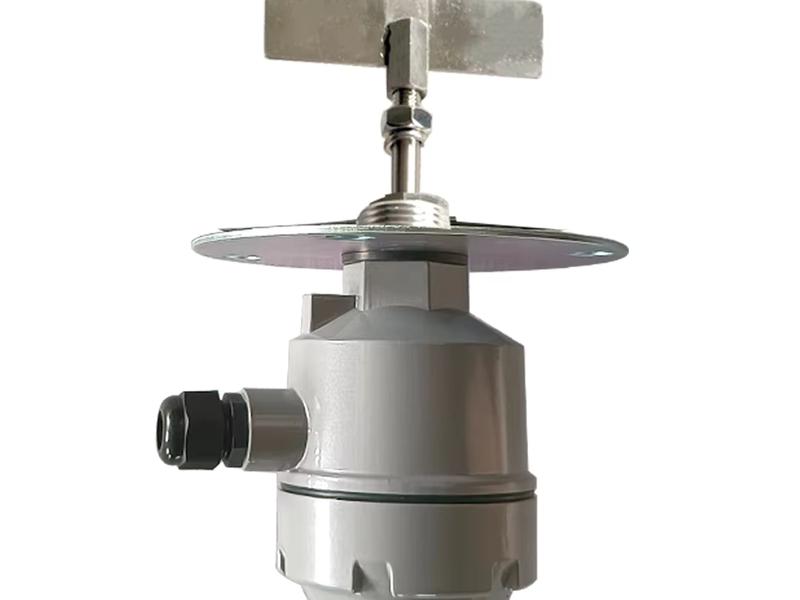
The rotary paddle level switch is the oldest and least expensive of the three and remains a workhorse in cement, grain, animal feed, plastics and mineral processing.
How It Works: Torque Detection
A small geared motor turns a paddle slowly — typically 1–5 rpm. In normal operation the paddle rotates freely through the headspace above the product. When bulk material reaches the paddle, it buries and stops the blades; the shaft can no longer turn, torque builds against the motor, and a microswitch (or a reed switch and magnet assembly) changes state. The control unit converts that state into a relay output. When the product falls away, a counterweight or spring returns the paddle to rotation and the output resets.
The principle is purely mechanical, so there is no dielectric constant, conductivity or capacitance to calibrate. You set one torque threshold and the switch either trips or it does not. That simplicity is the paddle's biggest selling point: no electronics to drift, robust against dust and vessel vibration, and easy for a maintenance crew to understand and troubleshoot.
Density Limits and Light Powders
Because the paddle must be physically stopped by the product, minimum density matters. A standard paddle typically detects products from about 100 g/L upward. For very light materials such as flour, fly ash or PVC dust, a low-density "light material" paddle with a larger, more easily stalled blade extends detection down to roughly 30–50 g/L. Below that, the paddle may rotate through the product without stalling — a classic failure mode in light powders.
Temperature, Pressure and Process Connections
Rotary paddles are atmospheric-to-low-pressure devices. Standard models suit process temperatures from about −20 °C to +80 °C; with a heat-extension shaft the electronics sit away from the flange and ratings rise to roughly 200 °C. Process connections are typically threaded (G1½ or G2) or flanged, and pressure capability is usually limited to about 0.3 MPa because the shaft seal must both rotate and seal the vessel.
The Weak Spots
The paddle has moving parts: a gear motor, shaft, bearing and rotating seal. In abrasive media such as cement or sand the bearing and paddle wear; in sticky solids a build-up can jam the paddle even when the vessel is empty, causing a false high alarm. Response time is on the order of a few seconds because the paddle must decelerate and torque must build. And a rotary paddle is generally unsuitable for liquids — the paddle's rotation meets resistance in any fluid and the motor does not stall reliably at the liquid interface.
Vibrating Rod Level Switch: Frequency-Shift Detection With No Moving Parts
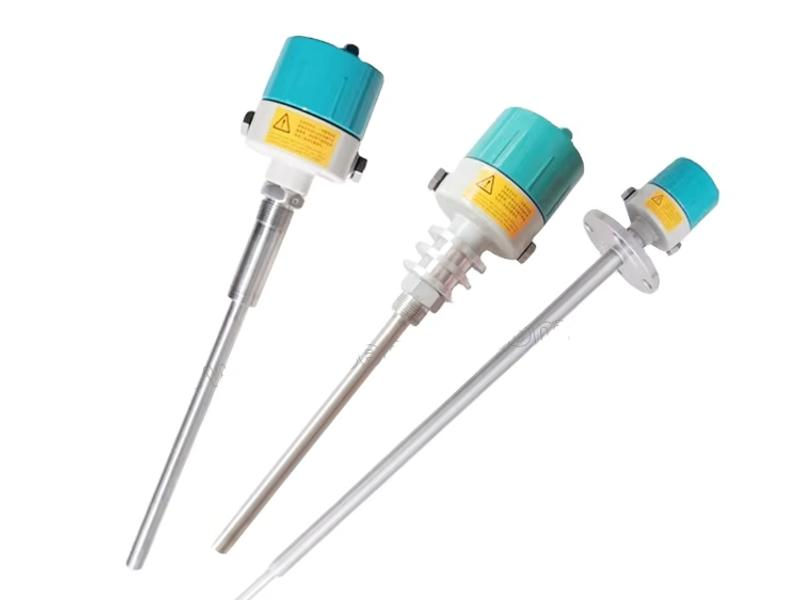
The vibrating rod level switch — built as a tuning fork with two tines, or as a single rod for coarse solids — is the modern replacement for the paddle in many bulk solids and most liquid point-level duties.
How It Works: Resonant Frequency Shift
A piezoelectric crystal drives the rod or fork into mechanical resonance. In air, a typical fork resonates at roughly 250–330 Hz. When the process medium covers the element, its mass and damping change, shifting the resonant frequency by a measurable amount — most electronics trigger on a shift of only a few hertz relative to the air baseline — and attenuating the vibration amplitude. The controller monitors that frequency shift and switches the relay within about 1–2 seconds of the medium reaching the sensor.
Why It Handles Light Powders and Liquids
Because detection relies on the medium touching the element and changing its resonant behaviour — not on density high enough to stall a motor — a vibrating rod can detect powders as light as about 20 g/L and, at the other extreme, any liquid regardless of conductivity or dielectric constant. This is the key difference from the paddle: the fork does not need the product to "stop" anything; it only needs the product to make contact.
The same physics covers granules, slurries, pastes and foam. The continuous vibration tends to shed adhering material, which is why forks are largely self-cleaning; genuinely sticky products can still bridge the tines, and a single-rod design or an RF admittance switch may be a better fit there. For dusty, low-density solids, the vibrating rod is the most reliable level switch for powders available in most plants.
Temperature, Pressure and SIL Ratings
Standard forks operate from about −40 °C to +150 °C; with an extension piece to keep the electronics away from the process temperature, high-temperature versions reach 250 °C, and compact forks are rated up to about 4 MPa (40 bar). With no moving parts, maintenance is essentially limited to checking the connection and cleaning the tines in very adhesive media. Many vibrating rod and tuning fork switches carry SIL 2 approval, making them a common choice for overfill protection and dry-run pump protection in safety loops.
RF Admittance Level Switch: Coating-Immune Detection for Liquids and Slurries
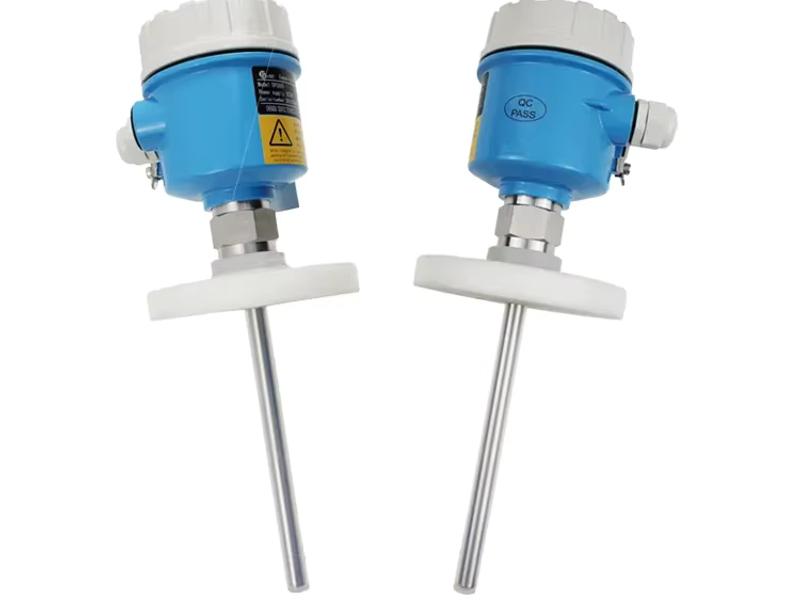
The RF admittance level switch is the specialist's choice where sticky coatings, conductive media, foam or interface detection defeat simpler probes.
How It Works: Admittance vs Capacitance
RF admittance is a close relative of RF capacitance, but with one crucial difference. A capacitance level switch measures only the capacitance between the sensing probe and the vessel wall or reference ground. That works well in clean media with a stable dielectric constant, but when a sticky liquid or slurry coats the probe, the coating's capacitance is added in series with the process capacitance and can be large enough to trip the switch falsely — the classic "cap coating" failure. An RF admittance switch measures admittance, the vector sum of conductance and capacitive susceptance, which alone is not enough to fix the problem. The real fix is the active shield.
The Active Shield: How Coating Immunity Is Achieved
The admittance probe has three elements: the sensing tip, a guard electrode, and the cable. The guard is driven by a unity-gain amplifier so it is held at exactly the same potential as the sensing tip. Because there is no potential difference between the sensing element and the guard, no current flows through the capacitance between them — and the capacitance of the probe coating, the cable and the guard-to-ground path all cancel out of the measurement. Only the change caused by process material touching the sensing tip affects the output. This active-shield (driven-shield) technique is what gives RF admittance its characteristic coating immunity: a wet, conductive coating that would false-trip a capacitance switch leaves an admittance switch measuring correctly.
An RF admittance level switch works on liquids, slurries, foam, interface layers and solids that present a dielectric contrast against air — down to dielectric constants around 1.5–2 with low-κ settings, which covers light powders and many hydrocarbons — and it handles both conductive and non-conductive media, making it the most broadly applicable of the three. Point detection is repeatable to about ±5–10 mm depending on probe geometry and mounting, with response times around a second. With the electronics in a remote housing, process temperatures up to 200–260 °C are typical, and pressures up to about 10 MPa (100 bar) are achievable with flanged or threaded connections.
The trade-offs: the instrument costs more than a paddle or fork, the probe must be selected for vessel geometry and media dielectric constant, and periodic cleaning may still be required where media form hard, insulating scale. There are no moving parts, so once the probe is correctly selected, maintenance is minimal.
Side-by-Side Comparison
| Feature | Rotary paddle level switch | Vibrating rod level switch | RF admittance level switch |
|---|
| Working principle | Motor-driven paddle stalled by material; torque trips a microswitch | Resonant rod/fork (~250–330 Hz) damped by media; frequency shift trips relay | Active-shield admittance probe; conductance + capacitance with coating cancelled |
| Typical media | Powders; granules; pellets; bulk solids | Powders from ~20 g/L; granules; slurries; and essentially all liquids | Liquids; slurries; foam; interface; and solids with dielectric contrast |
| Density / dielectric limit | ~100 g/L standard; ~30–50 g/L with light-material paddle | ~20 g/L in powders; no limit in liquids | Down to ~1.5–2 εr; conductive media supported |
| Accuracy / response | On/off at paddle position; ~1–5 s | Repeatable to a few mm; ~1–2 s | Repeatable to ~±5–10 mm; ~1 s |
| Pressure / temperature | ~0.3 MPa; −20 to +200 °C with extension | Up to ~4 MPa; −40 to +250 °C with extension | Up to ~10 MPa; −40 to +260 °C with extension |
| Coating immunity | Poor — build-up can jam the paddle | Good — self-cleaning vibration | Excellent — active shield nulls coating capacitance |
| Moving parts / maintenance | Gear motor; bearing; shaft seal; periodic checks | None; clean tines if adhesive | None; occasional probe cleaning in scale-forming media |
| Typical price tier | Lowest | Low–moderate | Moderate–highest |
How to Choose the Right Point Level Switch
For Powders and Bulk Solids
If your duty is dry solids — cement, flour, plastic pellets, fly ash, feed or sugar — the choice narrows to paddle versus vibrating rod. For coarse, heavy, abrasive products where cost matters and a few seconds of response is acceptable, a rotary paddle level switch remains the cheapest reliable option. For light powders below roughly 100 g/L, or where maintenance access is difficult, a vibrating rod level switch is the more robust choice because nothing has to stall and there are no moving parts. The same logic applies across silo and powder applications, where fork and paddle switches are the two proven high- and low-level solutions.
For Liquids and Slurries
For clean or lightly contaminated liquids, a vibrating rod (tuning fork) switch is the default: it works in any liquid regardless of conductivity, is unaffected by foam and vessel vibration, and is compact and inexpensive. For slurries, viscous products or conductive liquids that coat probes, an RF admittance switch with an active shield is the reliable answer — it keeps reading correctly where a capacitance switch would false-trip. Rotary paddles are effectively excluded from liquid duty, so a level switch for liquids will normally be a fork or an admittance probe.
For High Temperature and Hazardous Areas
Both paddle and fork designs can be supplied as high-temperature level switches for process temperatures above 150 °C, using extension pieces that keep the electronics remote and push ratings to 200–260 °C. For hazardous areas, specify an explosion-proof level switch with flameproof (Ex d) or intrinsically safe (Ex ia) approval matched to the dust or gas zone; WELK supplies explosion-proof tuning fork switches certified for Zone 20/21 dust and Zone 1/2 gas environments.
FAQ
Can a rotary paddle switch work in very light powders like flour?
Flour is a borderline case. A standard paddle needs roughly 100 g/L of density to stall reliably, and flour is usually around 40–60 g/L, so a standard paddle may rotate through it without tripping. With a light-material paddle, detection can be pushed down to about 30–50 g/L, but the margin is thin. Most engineers prefer a vibrating rod switch for flour and similar dusts because it detects down to ~20 g/L with no moving parts and no risk of the paddle spinning through the product.
Is a vibrating rod switch suitable for liquids?
Yes — that is one of its strengths. Because detection is based on resonant frequency shift rather than density or conductivity, the same fork family works in water, oils, solvents and conductive media alike. It is also suitable for slurries and pastes, although extremely viscous or bridging materials can load the tines. For clean liquids a compact tuning fork is the most common choice; for coating-prone slurries an RF admittance switch is usually the safer selection.
What does RF admittance mean and why is it better than capacitance?
RF admittance measures the total electrical response of the probe — the vector combination of conductance and capacitive susceptance — rather than capacitance alone. The important part is that admittance probes use an active shield: a guard electrode held at the same potential as the sensing tip, which cancels the capacitance of the cable and of any coating on the probe. A capacitance switch sees a coated probe as a level change; an admittance switch does not. That is why admittance is specified where sticky, conductive or foaming media would false-trip a capacitance switch.
Which switch do I need for a cement silo?
For cement, the two proven choices are a vibrating rod for low level — where the product is dusty, light and fines-heavy — and a rotary paddle for high level in the coarse end, though forks are increasingly used at both points. The vibrating rod's ability to detect below 100 g/L and shed dust by vibration makes it the more reliable low-level sensor; a paddle remains cost-effective for high level. See our detailed guide to silo level measurement for powders and cement for application notes and installation examples.
Do these switches need maintenance?
Minimally, but not equally. A rotary paddle has moving parts — motor, bearing and rotating seal — so it needs periodic checks, torque verification and, in abrasive media, paddle and bearing replacement. Vibrating rods and RF admittance switches have no moving parts; maintenance is limited to keeping the process connection tight and cleaning the element in adhesive media, and forks are largely self-cleaning. All three benefit from a scheduled check of relay wiring and function when used in SIL-rated safety duties.
Get a quote for your application. Not sure which point level switch fits your media? Send our engineers your material density or dielectric constant, particle size, process temperature and pressure, and vessel dimensions. They will recommend the right rotary paddle, vibrating rod or RF admittance switch — with the correct process connection and hazardous-area rating — and provide a quotation with delivery. Contact the WELK team at level-meters.com for a fast, no-obligation answer.